
|
Short answer: An inline cell makes sense when several operations share the same part, the same fixture and a takt time that manual stations cannot hold. The key engineering questions are not the machines themselves but the interfaces: part stopping and anti-collision, fixture return, safety guarding, and how data follows each part. |
Many electronics assembly lines grow one machine at a time. A screw fastening machine arrives first, then a dispenser, then a labeling station. Each machine works well on its own, but operators spend their shift carrying parts between them, waiting for the slowest station and fixing labels that went on the wrong unit. At some point the question changes from "which machine should we buy" to "should these machines be one cell on one conveyor". This article explains how to recognise that point, what an inline fastening, labeling, scanning and dispensing cell looks like, and which interface details decide whether it runs smoothly or stops every ten minutes.
Signs you have outgrown standalone machines
Standalone machines are the right choice for many factories. They are flexible, cheap to move and easy to replace. They become a bottleneck when the work around them costs more than the work inside them. Score your line against this checklist:
| Check | What to look for | Points to an inline cell if… |
| Handling share | Time operators spend loading, unloading and carrying parts between stations | Handling takes more operator time than the processes themselves |
| Waiting | Parts queuing in front of one station while others stand idle | The same station is the bottleneck every shift |
| Same part, same fixture | Do fastening, labeling and dispensing all happen on the same part in the same orientation? | Yes, and the part is re-fixtured at every station today |
| Traceability errors | Labels on the wrong unit, missed scans, records kept on paper | Your customer asks for a code linked to each unit |
| Staffing | How many stations depend on one experienced operator | Absence of one person slows or stops the line |
| Volume stability | How long the product stays in production without major changes | The product, or a family of similar products, runs for months or years |
If three or more rows apply, an inline cell is worth a closer look. If only one or two apply, a better fixture or a second standalone machine may solve the problem at lower cost. We deliberately do not give a fixed "labor saving" figure here, because it depends entirely on your current handling time, your takt and your product. A good supplier should help you measure your own baseline before promising anything.
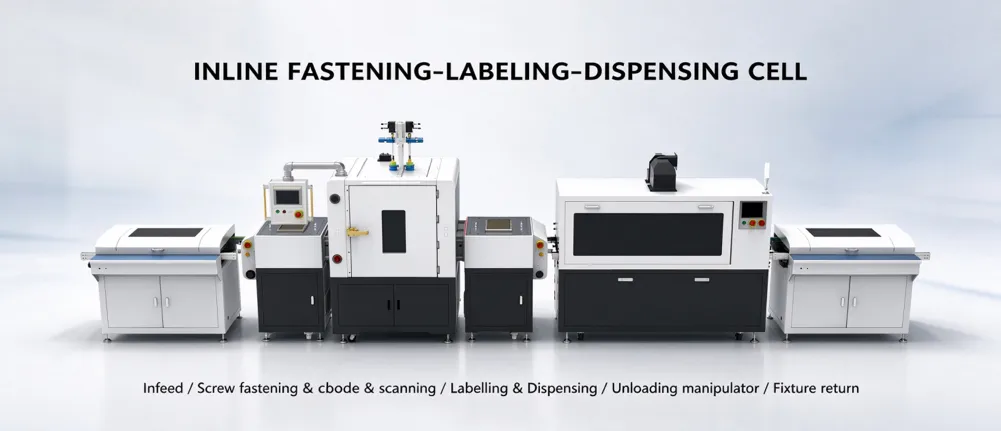
Anatomy of an inline fastening, labeling and dispensing cell
An inline cell is not just three machines in a row. It is one material flow with a shared fixture, a shared conveyor logic and machines that talk to each other. In the inline cell we build, the equipment consists of:
• An inline screw fastening machine. It tightens the screws while the part sits in the fixture. Our XY-SC3400 online auto screw tightening machine is an example: a 400 × 400 × 120 mm working area, a chain conveyor adjustable from 50 to 400 mm wide, servo motors with ball screws, adjustable torque settings and optional vision positioning.
• An inline labeling and code scanning machine. It applies the label and reads the code, so the unit has an identity before it leaves the cell.
• An inline dispensing machine with a pump-type glue supply. The pump system feeds the dispensing valve from a larger reservoir, so operators refill less often. For simpler jobs, an inline dispenser such as the XY-D3340 3-axis inline automatic glue dispenser can work on its own beside an existing line.
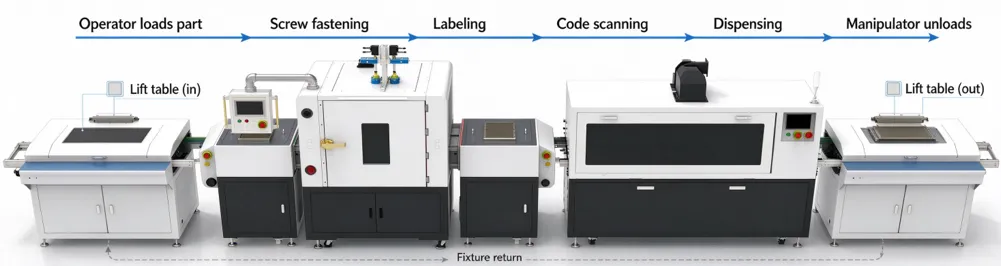
• Two fixture lifting tables and a fixture return. One table lifts the fixtures at the infeed, the other lowers them at the end, and the return conveyor brings the empty fixtures back to the operator.
• An unloading manipulator and an outfeed conveyor. The manipulator takes the finished product out of the fixture and places it on the outfeed line, which can be customised to your downstream line.
The working sequence is simple for the operator. They place the product into a fixture at the infeed. The fixture then flows through the cell, and the product is fastened, labeled, scanned and dispensed automatically. The manipulator unloads it, and the fixture returns for the next part.
The interface problems nobody quotes for
Most quotations describe the machines in detail and the transitions between them in one line. In practice, the transitions cause most of the stoppages. These are the details to ask about before you sign:
| Interface problem | What happens without it | How the cell handles it |
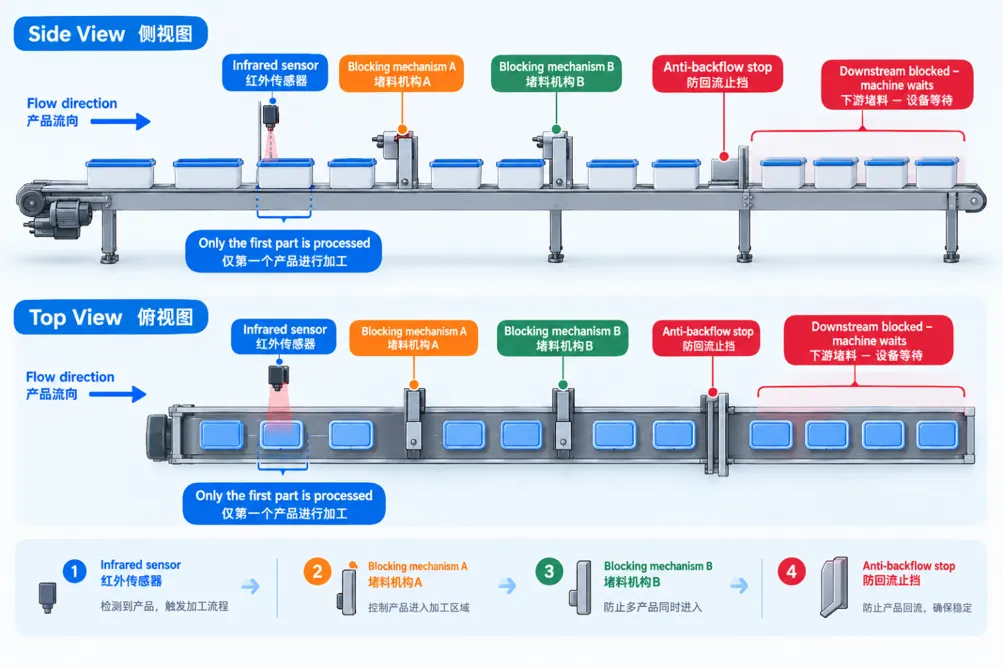
| Part stopping | The part is not in position when the process starts, so screws or glue land in the wrong place | A blocking mechanism on the conveyor stops the part. An infrared sensor detects its arrival and starts the stop and the process together |
| Anti-collision | Parts run into each other and shift in the fixture | Two blocking mechanisms (A and B) keep parts apart |
| Parts arriving nose to tail | The machine treats two touching parts as one and processes the wrong area | The infrared system recognises the queue and works on the first part only |
| Downstream blockage | The machine releases parts into a full conveyor and they jam | The machine detects the blockage, waits and restarts the cycle when the line is clear |
| Backflow | Pressure from the downstream line pushes a part back into the machine and causes a false start | An anti-backflow mechanism stops parts from flowing back into the machine |
When we scope a cell, we spend as much time on these points as on the screw or glue process. Ask your supplier how each one is solved, and ask to see it running on a video, not just in a drawing.
Safety and compliance
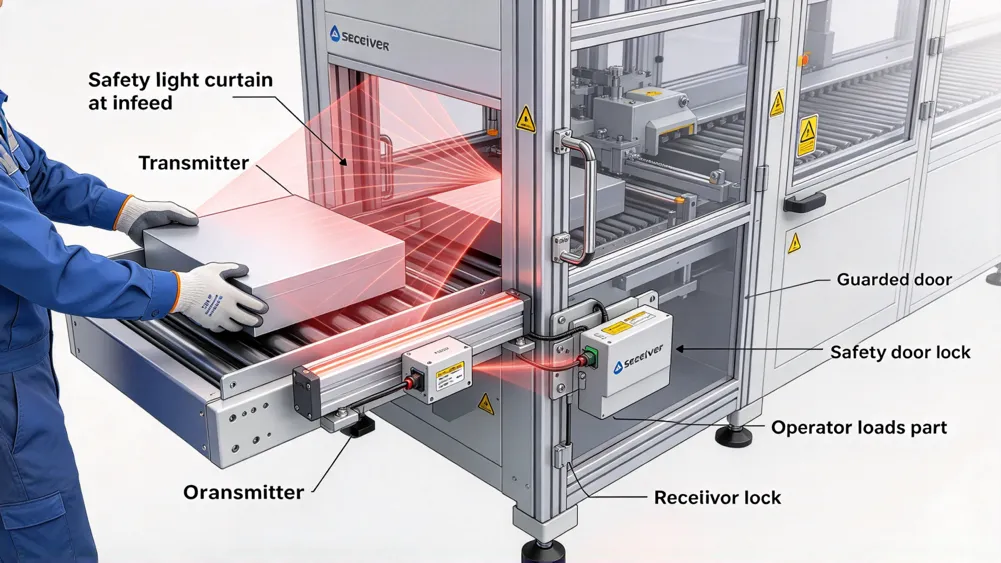
An inline cell removes the operator from most of the process, but not from the infeed. The infeed and the machine doors are where people and moving axes meet. In our cell, the manual loading point and the equipment doors are protected by safety light curtains, so the machine stops when a hand or body enters the protected zone.
For export projects, the safety design is usually reviewed against general machinery standards. ISO 12100 sets out how to assess and reduce risk on a machine. IEC 60204-1 (EN 60204-1 in Europe) covers the electrical equipment of machines. If light curtains are part of the safety concept, their position and safety distance also need to be checked. Which standards and which marking apply depends on your market and the final configuration, so agree this in writing during the quotation. We confirm the compliance documents for each project rather than making a general claim for the whole line.
Data and traceability
Traceability is often the real reason for an inline cell. When the label is applied and scanned inside the same cell that fastens and dispenses the part, the code is attached to a known unit at a known point in the process. There is no separate manual labeling step where a label can end up on the wrong unit.
Each machine in our cell has its own touchscreen. It stores roughly the last month of abnormal alarms and output data, and the machines communicate with each other. That is enough for supervisors to see which station stopped, why and how often, without a separate system.
If you need to send data to a factory MES, treat it as a project requirement rather than a standard feature. Tell the supplier which data you need per unit (for example scan code, alarms, count), which MES you use and how it receives data. The interface then depends on the machines and controllers chosen, and should be confirmed before the order.
|
Write your data needs on one page before the first supplier meeting: which code, which events, which format and who reads it. A one-page data list saves weeks of back-and-forth during commissioning. |
Modular vs monolithic lines
A monolithic line is designed as one machine. It can be compact, but it is hard to split, move or reuse when the product changes. A modular cell is a set of complete machines joined by the conveyor, the fixture flow and the control cables.
In our cell, the machines are connected by aviation plugs. To split the cell, you unplug the connectors between the machines. This matters in three situations:
• Product change. When the product ends, the screw fastening machine or the dispenser can be reused on another line or as a standalone station.
• Factory move. Separate machines are easier to ship, rig and reinstall than one long frame.
• Phased investment. You can start with one inline machine on your existing conveyor and add the others when volume justifies them.
How to scope a project with a supplier
A clear brief shortens the quotation and avoids surprises at acceptance. Before you contact a supplier, prepare:
| Item | What to send | Why it matters |
| Product | Samples or 3D files, with screw, label and glue positions marked | Decides fixture design, axis travel and vision needs |
| Takt time | Target output per hour or per shift | Decides whether one machine per process is enough |
| Screws | Size, length, head type, material and required torque | Decides screwdriver, feeding method and torque setting |
| Label and code | Label size, content, code type and position | Decides the labeling head and scanner |
| Glue | Brand, type, viscosity and TDS | Decides the valve and the glue supply |
| Your line | Conveyor height, width, flow direction and floor space | Decides how the cell connects to your line |
| Data and safety | Traceability fields, MES details, target market and standards | Decides controls, interfaces and documents |
On larger projects, we work through the full sequence: layout planning, process design, equipment selection, line engineering, manufacturing, shipping, installation and commissioning, and final acceptance. You can see how this worked on a recent automotive dispensing and curing line project. For details on support after delivery, see our service page.
Dongguan Xinhua Intelligent Manufacturing Co., Ltd. (XINHUA) builds dispensing, potting, screw fastening and UV curing equipment under an ISO 9001:2015 quality management system. If you are weighing standalone machines against an inline cell, send us the items above, and book a 30-minute line-scoping call with an automation engineer through our contact page.
FAQ
Can the cell connect to our existing conveyor height and direction?
Yes, that is what inline machines are designed for. The cell connects directly to your assembly line, and the outfeed conveyor can be customised. Send us your conveyor height, width and flow direction, and we confirm the connection in the layout drawing.
What happens when the downstream conveyor is blocked?
The machine detects the blockage and waits. It restarts the cycle automatically when the blockage is cleared. An anti-backflow mechanism also stops parts from being pushed back into the machine.
Can each machine be used standalone later?
Yes. The machines are connected by aviation plugs, so you can unplug them and use a machine on its own or on another line. Fixtures and programs may need to be adapted for the new product.
Can scan data be sent to our MES?
It can be planned, but it is project-specific. Tell us which data you need per unit and how your MES receives it, and we confirm the interface during the quotation. Without an MES, each machine stores roughly one month of alarm and output records on its touchscreen.
How long does it take to build and commission an inline cell?
It depends on the number of processes, the fixture design and how complete the brief is. Sample trials and process verification come first, then manufacturing, then installation and commissioning. On one recent automotive dispensing line, sample trials started in March 2026 and the line was delivered in April 2026. We give a schedule for your project with the quotation.