
Short answer: Before paying a deposit, verify four things: that the certificate holder and scope match the factory you are buying from, that the supplier has run your part and fluid in a documented trial, that acceptance criteria are written into the contract as a factory acceptance test, and that spare parts and remote support are defined in writing.Buying a dispensing or potting machine from China is now routine for many factories in Europe, the Americas and Southeast Asia. The prices are competitive and the range is wide. The risk is that a machine that looked good in a video arrives, gets installed, and still cannot hold your bead width or mix ratio on your part. By then the deposit and the balance are both paid.
We build dispensing, potting, screw fastening and UV curing equipment in Dongguan, and we answer supplier questionnaires from overseas buyers every month. This guide is the checklist we would use if we were on your side of the table. It works for any supplier, including us.
Why dispensing equipment is riskier to buy than it looks
A dispensing machine is not a standard product like a motor or a pump. Its result depends on three things that the supplier does not control: your fluid, your part and your takt time. The same machine can lay a perfect bead of one adhesive and string, tail or trap air with another.
That is why a catalogue specification is only the starting point. Repeatability of the XYZ axes tells you how accurately the needle moves. It does not tell you how consistent the glue volume will be, how the material behaves after an hour in the hose, or whether the cure works on your substrate. Those answers come only from a trial with your own materials and from acceptance criteria you can enforce.
So the checklist below focuses on proof, not on promises. Each point is something you can ask for, see or put in writing before money moves.
The 12-point checklist
Print this table and use it in your supplier meetings. If a supplier cannot satisfy a point, it is not always a deal-breaker, but you should know why and decide with your eyes open.
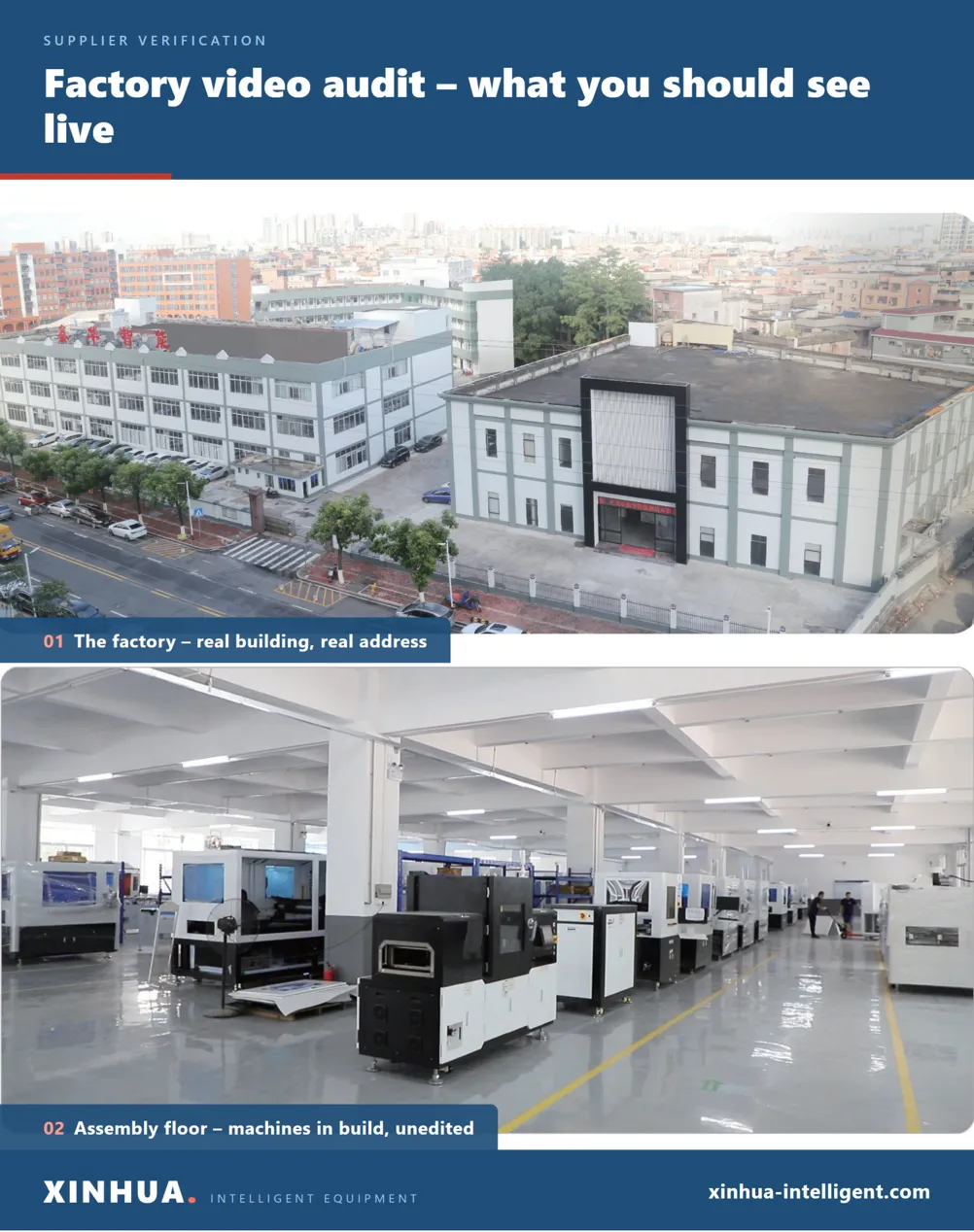
# Check What good looks like Red flag 1 Certificate holder and scope The company name and address on the ISO certificate match the company on your contract and invoice, and the scope covers the equipment you are buying. Certificate belongs to a related company, or the scope covers something else (for example, machined parts). 2 Certificate can be verified The certificate number can be found on the certification body's website or a public database, with matching dates. No number, no issuing body, or the supplier refuses to share a full copy. 3 Factory visit or live video audit You see the assembly floor, the test area and machines in build, live and unedited. Only showroom photos or pre-recorded videos. 4 Experience with your process The supplier can explain similar applications (fluid type, part size, takt) without naming other customers. "We can do everything" with no process questions asked. 5 Trial with your part and fluid Your parts and your fluid are run on a comparable machine before you order. Trial on a demo part with the supplier's own glue. 6 Trial report with conditions The report states the fluid, needle or valve, pressure or speed, temperature and measured results, with photos. A video and the word "OK". 7 Written technical agreement Standard and optional items are listed by model and part, including software, vision and feeding options. Configuration described in one line of the quotation. 8 Factory acceptance test (FAT) Takt, accuracy, run time and reject criteria are agreed in writing before production starts. "You can check it when it arrives." 9 Packing, shipping and installation plan Crating, moisture protection, rigging points and the installation schedule are defined. No plan until the balance is paid. 10 Training and documentation English manual, electrical drawings, parameter list and a training plan for operators and maintenance staff. Manual only in Chinese, or "we will send it later". 11 Warranty and spare parts list Warranty period, what it covers and a recommended spare parts list with prices. Warranty "included" with no terms. 12 Remote support and response time A named contact, a response time and a method for remote diagnosis. A sales contact only, with no service process. How to read a supplier's certificate
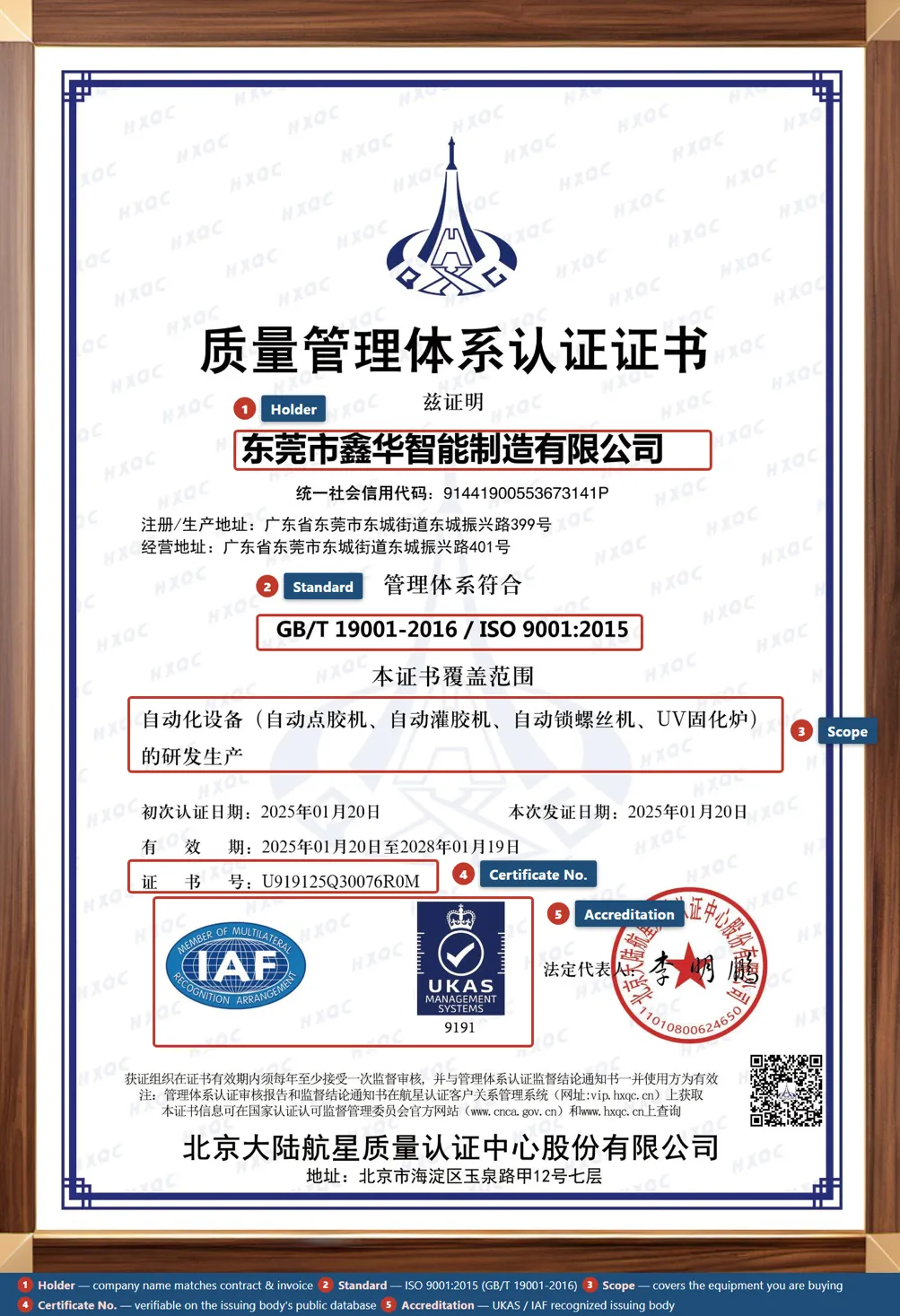
An ISO 9001 certificate is useful only if you read it properly. Five fields matter: the holder's legal name, the address, the scope, the validity dates and the certification body. Here is how they look on our own certificate, which we share with every buyer who asks.
- Holder. Dongguan Xinhua Intelligent Manufacturing Co., Ltd. This is the same legal entity that signs our sales contracts. If a supplier's certificate shows a different company, ask how the two are related and which one will sign your contract.
- Scope. Our ISO 9001:2015 scope covers the research, development and production of automatic dispensing machines, potting machines, screw locking machines and UV curing ovens. A certificate whose scope covers only trading, or a different product, says little about how your machine is built.
- Number and dates. Certificate U919125Q30076R0M, valid from 20 January 2025 to 19 January 2028. Check that the dates on the copy match the dates in the certification body's records.
- Surveillance. A three-year ISO certificate normally depends on periodic surveillance audits. It is fair to ask for the latest surveillance audit result, not just the certificate.
- Other registrations. We are registered as a National High-tech Enterprise (certificate GR202344004036, issued 28 December 2023).
- To check a certificate issued in China, search the number in the certification body's own online register, or in the national certification database run by China's Certification and Accreditation Administration (CNCA). Many accredited bodies also list their certificates on IAF CertSearch. If the number cannot be found anywhere, treat the certificate as unverified.
Be careful with certificate walls. A trade-show banner with ten logos tells you nothing. One certificate with a matching holder, a relevant scope and dates you have checked tells you a lot.
What a good sample trial looks like
A sample trial is the single most useful step before an order. It turns the supplier's claims into results on your part. A good trial has a clear goal, uses your materials and ends with a written report.
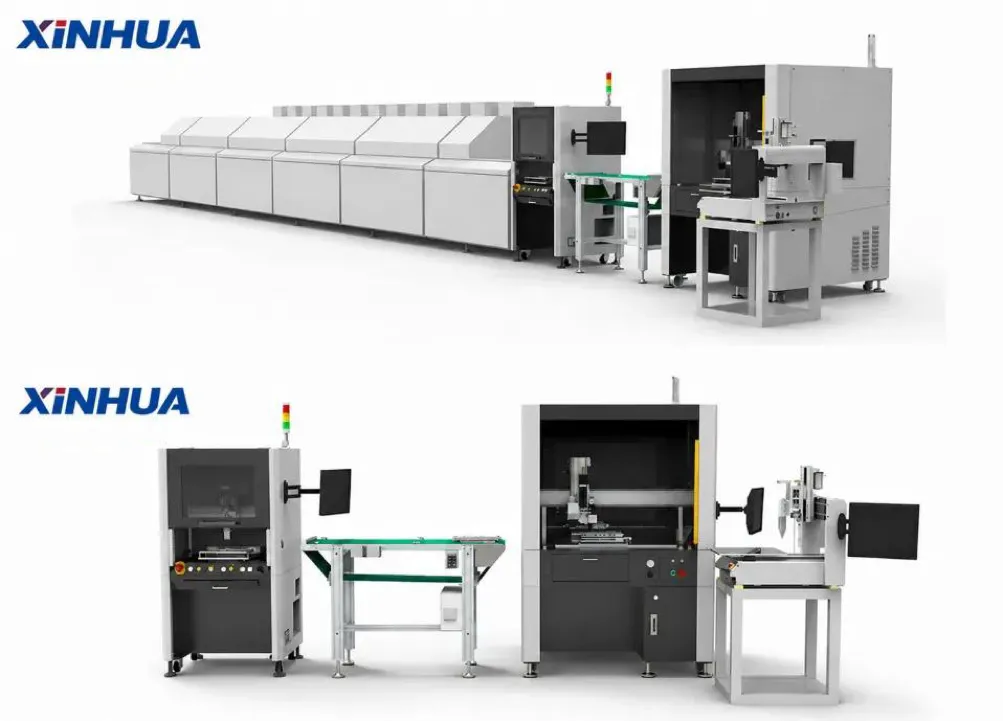
Our 2026 automotive electronics project is a typical sequence. In March 2026 the customer and its end user asked us to test their product and verify the process. The test targets were dispensing accuracy, bead dimensions, corner geometry and overlap tolerance. A project team of sales, project, product and solution engineers worked through the requirements with the customer. After the trial and the bid, the dispensing and curing line was delivered on schedule in April 2026 and went into operation. You can read the project summary on our blog.
Whichever supplier you use, ask for these items in the trial report:
- Materials. Fluid brand and grade as received, mix ratio for two-component materials, and the batch or date code.
- Equipment set-up. Machine model, valve or pump type, needle size, pressure or speed, and any heating.
- Measured results. Bead width and height, dot size, or fill weight, with the number of samples and how they were measured.
- Problem areas. Corners, overlaps, start and stop points, and anything that needed a work-around.
- Photos and video. Close-ups of the result on your part, not only the machine running.
Writing a factory acceptance test you can enforce
A factory acceptance test (FAT) is the check you run at the supplier's factory before the machine ships. It is your last point of strong leverage, because the balance payment is usually tied to it. The test is only as good as the criteria written in the contract.
FAT item How to define it Example wording Cycle time Seconds per part or per fixture, measured over a run, not a single cycle Average cycle time ≤ X s over 100 consecutive parts Dispensing result Bead width, height or weight, with tolerance and measuring method Bead width X ± Y mm at 10 marked points, measured by microscope Ratio (two-component) Mix ratio check by weighing A and B separately Ratio within the rated tolerance at three flow settings Continuous run Duration without unplanned stop 4-hour run with no alarm caused by the machine Reject criteria What counts as a defect and how many are allowed No voids visible in the cut section of 5 potted samples Safety and documents Guards, emergency stops, labels, manuals and drawings All items on the agreed document list delivered in English The numbers in the example column are placeholders. Agree real values with the supplier after the trial, because the trial shows what your fluid and part can achieve. Repeat a short version of the FAT after installation at your site, as a site acceptance test, so that you can confirm nothing changed in transit.
Ask the supplier to run the FAT with your fluid and your parts, not with water or a demo part. Ship the materials to the supplier early enough, and check their shelf life.After-sales service across borders
After-sales service is where the distance between you and the supplier shows. Get it in writing before you order, and be specific about what happens in the first week of a problem.
Our standard service terms, as published on our service page, are a one-year warranty on the complete machine, free replacement of faulty parts during the warranty, online diagnosis with on-site repair when needed, and a 24-hour online response. We keep original spare parts in a standardized spare parts inventory, supply a set of wearing parts with each machine and provide inspection reports for spare parts. Installation, commissioning and operator training are part of our service.
Whichever supplier you choose, clarify these boundaries:
- What the warranty excludes. Wearing parts, damage from wrong fluids, and consumables are usually excluded. Ask for the list.
- Who travels, and who pays. On-site service outside China often involves visas, travel time and travel costs. Agree in advance who covers them during and after the warranty.
- Spare parts on your shelf. Buy the recommended wearing parts with the machine, so a worn seal or nozzle does not wait for international freight.
- Remote access. Decide whether the machine may be connected for remote diagnosis, and what your IT policy allows.
- Local presence. Ask where the supplier's nearest service staff are based.
Red flags that should slow you down
None of these alone proves a supplier is unreliable. Together, they are a reason to pause before paying.
- The certificate holder and the selling company do not match, and nobody can explain why.
- Specifications only say "maximum" or "fastest". Good specifications state conditions, such as viscosity, needle size or test part.
- The supplier will not run your part. A refusal to trial, or a trial only with their own glue, hides the real risk.
- Customer logos without context. A wall of famous brands is not evidence of a project. Ask what was supplied and when, and accept that some details are confidential.
- Unverifiable claims. Large numbers of patents, countries or customers mean little unless the supplier can back them up when you ask.
- Pressure on payment terms. A full payment before the FAT removes your leverage.
Using this checklist with us
If you are comparing suppliers for a dispensing, potting, screw fastening or curing project, you can hold us to every point above. We share our certificate copies, run trials with your parts and fluid, write the configuration into a technical agreement and agree the FAT criteria before production. For more background on how custom machines are scoped, see our article on custom automatic dispensing machine manufacturers, and learn more about XINHUA.
Dongguan Xinhua Intelligent Manufacturing Co., Ltd. (XINHUA) has worked in automatic dispensing equipment since 2004 and builds its machines under an ISO 9001:2015 quality management system. Send your part drawing, fluid data sheet and takt target through our contact page to request a sample trial, and ask for a printable copy of this 12-point checklist.
FAQ
How can I verify a Chinese supplier's ISO 9001 certificate?
Ask for a full copy that shows the holder, address, scope, certificate number, dates and certification body. Then search the number in the certification body's online register or in the national certification database run by China's CNCA. The holder and scope should match the company and the equipment in your contract.
Will you test my product before I place an order?
Yes. We run trials with the customer's own parts and fluid, and report the set-up and measured results. Send samples, the fluid data sheet and your quality targets so that we can plan the trial on a comparable machine.
What does your warranty cover and for how long?
Our standard terms are a one-year warranty on the complete machine, with free replacement of faulty parts during the warranty. Wearing parts and damage from incorrect use are normally excluded. The exact terms are written in the sales contract.
Do you provide on-site installation outside China?
Installation, commissioning and training are part of our service, and online diagnosis is the first step for most issues. For overseas sites, we agree the scope, schedule and travel arrangements in the contract, so both sides know what is included.
What documents come with the machine?
You should receive an operation manual, electrical drawings, a parameter list for your product, a spare and wearing parts list, and the FAT record. Ask for English versions in the contract.