
Short answer: Floating and missed screws are detected by monitoring each tightening cycle, torque and ideally angle or depth, against a defined window, and by stopping the line when a screw falls outside it. Automatic screw fastening machines with torque detection and alarms turn every screw into a recorded pass or fail result instead of an operator's judgment.A missing screw in a heat sink, a lamp housing or a small appliance rarely shows up on the assembly line. It shows up later, as a rattle, a hot spot or a field return. When the customer asks for the tightening records of that batch, many factories have nothing to show except a work instruction that says "tighten to spec".
Manual electric screwdrivers can be set to a clutch torque, but nobody records whether each screw actually reached it. This article explains the four common fastening failures, what a machine has to measure to catch them, and how to turn screw fastening into a process that leaves a record.
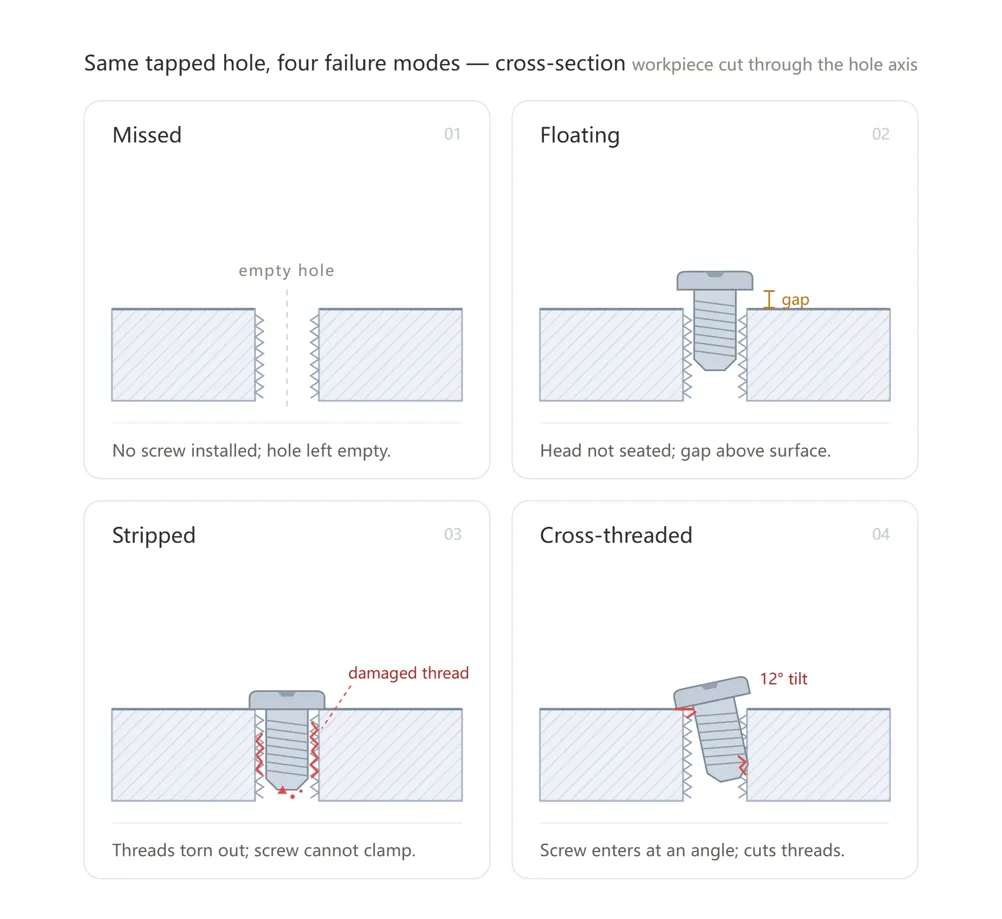
The four failure modes: missed, floating, stripped and cross-threaded
Each failure has a different cause and leaves a different signature in the tightening cycle. That signature is what a monitoring system looks for.
Failure What happened Typical cause Consequence Missed screw No screw was driven into the hole Feeding fault, screw dropped from the bit, operator skipped a hole Loose part, vibration, rattle, safety risk Floating screw Screw sits above the seat and the head does not clamp the part Short thread engagement, burr or debris, wrong screw length, clutch released early on friction Loss of clamp force, poor thermal contact, loosening over time Stripped screw Thread in the part or the screw recess is damaged Torque or speed too high, worn bit, poor vertical alignment No clamp force, damaged part, rework Cross-threaded screw Screw enters the hole at an angle Misalignment between bit and hole, fixture play False torque reading, damaged thread, later loosening Stripping is mostly a set-up problem. Our article on stripped screw heads and inaccurate screw feeding covers bit wear, torque and speed settings and alignment in detail. This article focuses on detection: knowing, for every screw, whether it is good.
Torque alone vs torque plus angle or depth
A screwdriver with a torque check confirms one thing: that the final torque reached the target. That is useful, but it is not enough to catch every failure.
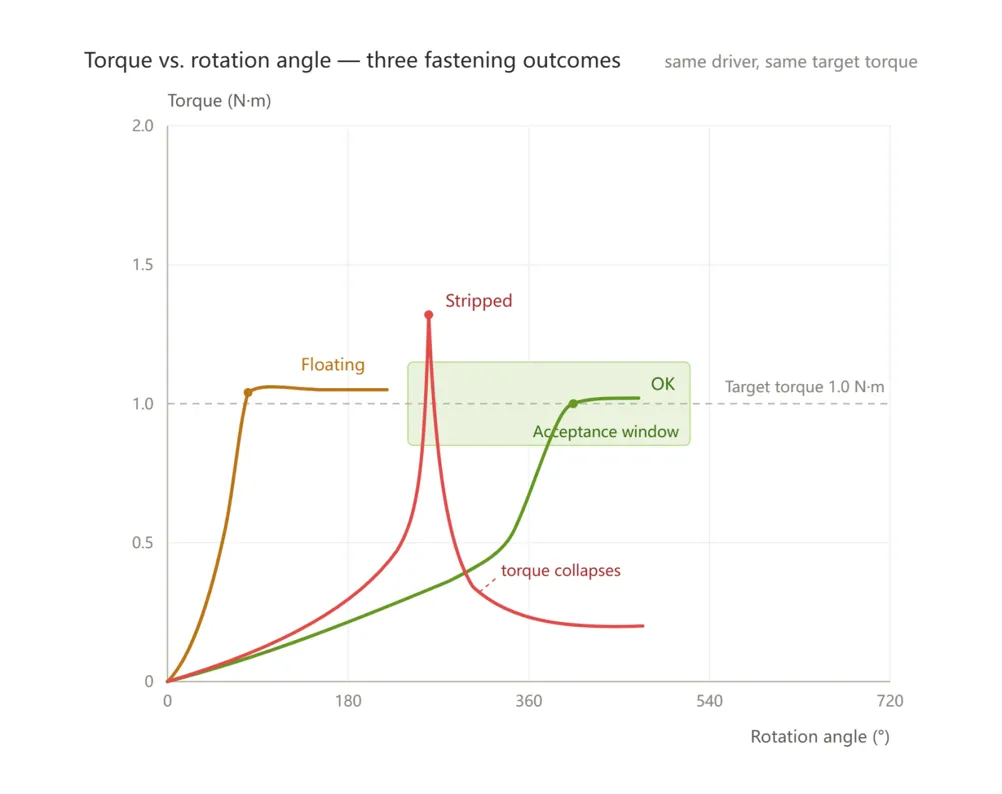
A floating screw can reach the target torque before the head is seated. Friction from a burr, debris in the hole or a cross-thread produces the same torque as a properly seated screw. Measured on torque alone, the bad screw passes.
This is why the industry uses a window instead of a single value. A good cycle reaches the target torque within an expected range of rotation angle or screw travel. If the torque arrives too early, the screw is probably floating or cross-threaded. If it arrives too late or not at all, the thread may be stripped or the screw may be missing. Measuring the Z-axis height or travel at the end of the cycle is another way to confirm the head is seated.
What is monitored What it catches What it can miss Final torque only Under-torque, slipping clutch, no screw at all (torque never reached) Floating and cross-threaded screws that reach torque early Torque + rotation angle Early torque (floating, cross-thread), late torque (stripped) Wrong screw length if the angle window is too wide Torque + screw depth or Z travel Head not seated, screw too long or too short Thread damage if depth is still within range Screw presence before tightening Empty bit, dropped screw, feeding fault Anything that happens during tightening On our XY-AS373-T three-station automatic screw fastening machine, torque detection and automatic alarm are built into the machine. When a screw falls outside its setting, the machine alarms instead of passing the part.
Setting the window is a process task, not a machine default. Tighten a sample of good screws on real parts, record the torque and angle or depth, and set the limits around that population. Then deliberately create a floating screw and a missing screw to confirm that both trigger the alarm.
Test the alarm before you trust it. Put a washer under a screw head or leave one hole empty during commissioning, and make sure the machine stops. A monitoring system that has never been seen to reject a part has not been proven.
Feeding method: suction or blow feed
Many missed screws start in the feeder, not in the screwdriver. The way screws reach the bit affects both speed and reliability. Our screw fastening machines are available with suction (vacuum pick-up) or blow feeding.
Suction (vacuum pick-up) Blow feed How it works The bit picks a screw from the feeder by vacuum and carries it to the hole Compressed air blows each screw through a tube to the nozzle Best for Short screws, screws with a large head, small sizes, products that cannot tolerate air Screws clearly longer than their head diameter, high cycle rates Speed Lower, because the head travels to the feeder Higher, because the screw comes to the head Watch out for Worn or dirty nozzles, vacuum leaks Tube jams, screws flipping, air pressure fluctuation As a rule of thumb, blow feeding needs a screw that is noticeably longer than its head is wide, so that it cannot turn over in the tube. Short, flat-head or very small screws usually go with suction. For reference, the feeder on the XY-AS373-T is specified for M1 to M4 screws, and the XY-SC3400 page lists M1.0 to M6.0, customizable.
In vacuum pick-up systems, a vacuum signal can also show whether a screw is on the bit before tightening starts. That closes one gap in missed-screw detection.
Multi-spindle, multi-station layouts
Adding screwdrivers is the most direct way to raise output, but the gain depends on how the screws are divided. We avoid quoting a fixed efficiency multiple, because the real number depends on your product. Use this method instead.
- Count the work. List the screws per product and the time per screw, including the move between holes and the tightening itself.
- Split the work. Divide the screws among the screwdrivers or stations so that each one has a similar amount of work. The slowest station sets the cycle time.
- Add the fixed time. Loading, unloading and fixture movement happen once per cycle, whatever the number of screwdrivers.
- Compare. Cycle time = slowest station's screwing time + fixed time. Compare this with your takt time, not with a single-spindle machine.
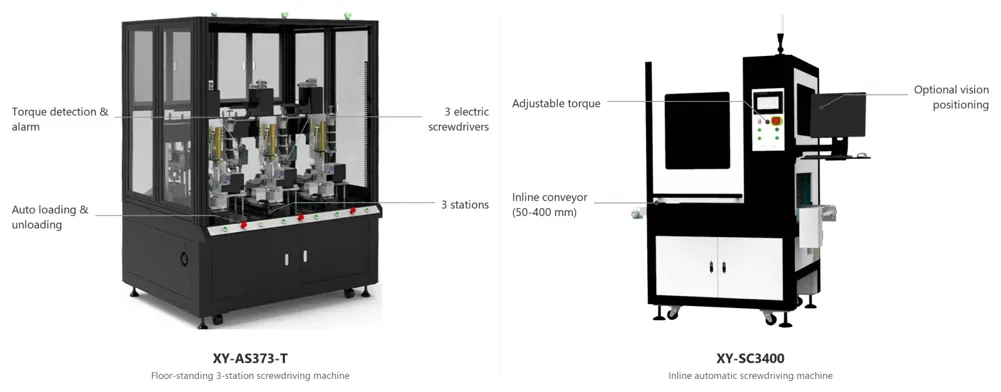
The XY-AS373-T is a floor-standing machine with three stations and three electric screwdrivers working at the same time, with three screw feeders and automatic loading and unloading. The number of screwdrivers can be increased to suit the product. Its working area is X1/X2 330 mm, Y1/Y2 700 mm and Z1/Z2 100 mm, with positioning accuracy of ±0.01 to 0.03 mm (rated). Because each station has its own screwdriver, each one can have its own torque setting and alarm.
For products that move along an assembly line, the XY-SC3400 online auto screw tightening machine docks directly onto the existing conveyor, with a chain conveyor adjustable from 50 to 400 mm and optional vision positioning. It offers adjustable torque settings, real-time monitoring and fault alarms on its PLC and touchscreen interface. For screw-by-screw torque detection on an inline machine, confirm the configuration with us at the quotation stage.
Building traceability
Detection stops a bad part. Traceability proves, weeks later, that a good part was good. The two are linked but not the same, and traceability needs a few more pieces.
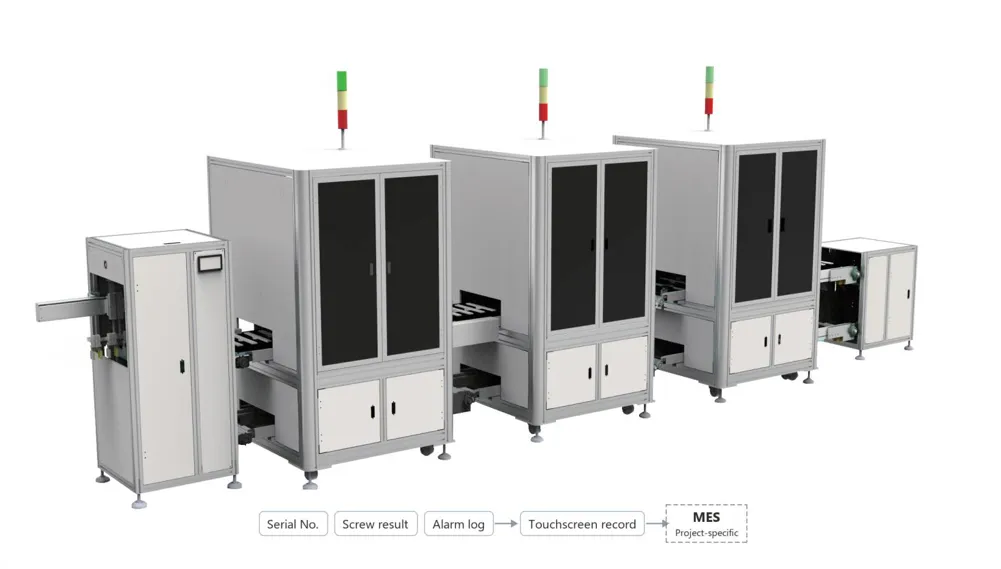
- An identity for each part. A label or a code that is applied and read in the same cell as the fastening, so results can be tied to a serial number.
- A result per screw or per part. At minimum a pass or fail per part; ideally the torque and the alarm reason per screw.
- Alarm history. Which alarms occurred, when, and what the operator did about them.
- A way to get the data out. Export to a file, or an interface to your MES. Treat an MES connection as a project requirement and confirm it in the technical agreement.
In our inline screw fastening, labeling, code scanning and dispensing cell, each machine has its own touchscreen that stores roughly the last month of abnormal alarms and output data, and the machines communicate with each other. Because the label is applied and scanned inside the same cell that fastens the screws, the unit has an identity before it leaves. We explain the full cell in our article on standalone machines versus an inline cell.
Data to prepare before you ask for a quote
A screw fastening proposal is only as good as the information behind it. Prepare these items before you contact a supplier.
Item What to send Why it matters Screw specification Size, length, head type, drive type, material and coating, plus a few samples Decides the feeder, the bit and suction or blow feeding Torque requirement Target torque and tolerance for each screw, and how you verify it today Decides the screwdriver model and the alarm window Hole map Drawing or photo with all screw positions, heights and approach directions Decides the axes, working area and fixture design Part material Plastic, die-cast, sheet metal, threaded insert, self-tapping or machine thread Affects speed, torque window and stripping risk Takt time and volume Seconds per part, shifts per day, planned volume Decides the number of screwdrivers and stations Records required What data per part your customer or auditor asks for Decides labeling, scanning and data export Getting a fastening station proposal
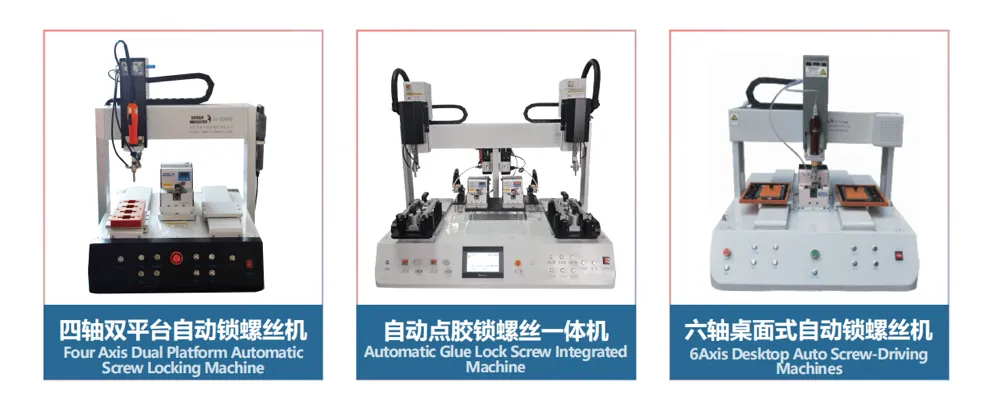
Dongguan Xinhua Intelligent Manufacturing Co., Ltd. (XINHUA) builds automatic screw fastening machines, from desktop and four-axis dual-platform models to the XY-AS373-T three-station machine and the XY-SC3400 inline machine, under an ISO 9001:2015 quality management system. Send your screw specification, torque requirement and hole map through our contact page, and we will come back with a fastening station proposal and a sample test plan for your part.
FAQ
Can a screw fastening machine detect floating screws?
Yes, if it monitors more than final torque. A floating screw often reaches the target torque early, so the machine needs to check the torque against rotation angle or screw depth. Confirm with the supplier which signals the machine actually measures, and test it with a deliberately floating screw during acceptance.
What torque range can the electric screwdrivers cover?
It depends on the screwdriver model fitted to the machine, which is chosen from your screw size and torque requirement. Send the target torque and tolerance for each screw, and we select the screwdriver and confirm the range in the proposal.
Suction or blow feeding: which is better for M2 screws?
It depends on the screw shape more than the thread size. Blow feeding is faster but needs a screw that is clearly longer than its head is wide. Short or flat-head M2 screws usually run better with suction. Send samples and we test the feeding on your screws.
Can torque data be exported?
Our machines store alarm and output records on the touchscreen. If you need torque values per screw exported to a file or sent to your MES, specify it at the quotation stage so the data format and interface can be agreed in the technical agreement.
How many screwdrivers can run at the same time?
The XY-AS373-T runs three electric screwdrivers at the same time as standard, one per station, and the number can be increased to suit the product. The right number depends on your screw count and takt time.