
| Short answer: Voids in potted electronics come from three places: air mixed into the compound, air trapped by the part's geometry, and gas released while the compound cures. Degassing the resin in its tank only fixes the first one. Potting the part inside a vacuum chamber fixes the first two. A multi-stage vacuum line does this without adding the long pump-down time of a single chamber to every cycle. |
If you build BMS boards, power modules, micro-inverters, sensors or LED drivers, you have probably seen it: the part passes visual inspection, then fails a hi-pot test, runs hot, or cracks after thermal cycling. When you cut it open, there are voids around the tallest components or under the densest pin rows. This article explains where those voids come from, which ones vacuum potting can and cannot fix, and how to decide whether a vacuum potting line is worth the investment for your product.
Where do voids in potted assemblies actually come from?
Most void problems get blamed on “bad resin”. In practice, the source is usually one of three mechanisms, and each one needs a different fix.
| Void source | What it looks like | Typical cause | How to detect it |
| Air in the mixed compound | Many small, round bubbles spread through the whole volume | Air whipped in during mixing; no degassing; poor cartridge or tank handling | Clear sample cup of the mixed material; cross-section |
| Air trapped by geometry | Larger voids under components, between tall parts, in blind corners and pin rows | Compound flows over a gap faster than air can escape; pouring from one point only | X-ray; cross-section through the densest area |
| Gas released during cure | Bubbles near the surface or around specific components; foamy skin | Moisture reacting with polyurethane; volatiles; exotherm too high; damp PCB | Compare with a pre-dried board; check humidity and cure profile |
A quick way to separate the first two: pour the same mixed compound into a clear cup with no part in it. If the cup is clean but the part still has voids, the air is coming from the geometry, not from the material.
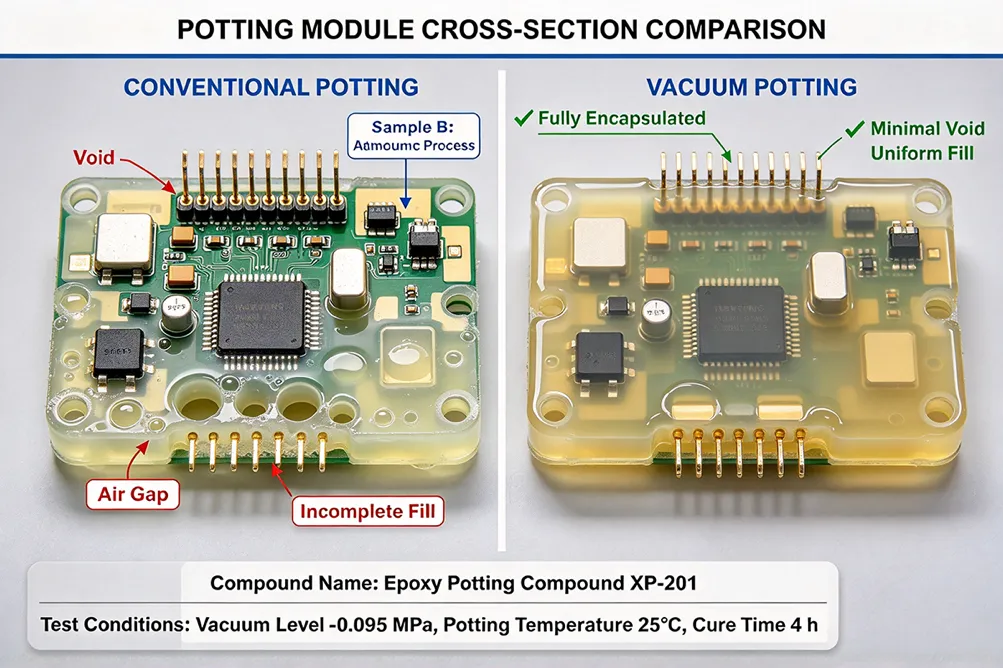
Why degassing the resin alone is not enough
Many lines already degas the A and B components in vacuum tanks before dispensing. This helps, and it is worth keeping. But once the degassed material is poured onto a real assembly at atmospheric pressure, it can seal off pockets of air under components, inside connector housings and around transformer windings. That air has nowhere to go.
When you pot inside a vacuum chamber, there is very little air left in those pockets to begin with. When the chamber returns to atmospheric pressure, the outside pressure pushes the compound into the spaces that the air used to fill. This is why vacuum potting is standard for parts with complex geometry and high reliability requirements.
| Rule of thumb: if your assembly has components taller than the surrounding gap, dense pin rows, or enclosed cavities, material degassing alone will rarely get you to a consistent void-free result. |
Atmospheric, single-chamber vacuum, or 3-stage vacuum potting?
There are three common approaches. The right one depends on part complexity, volume, and how much a single failed unit costs you.
| Atmospheric potting (degassed material) | Single-chamber vacuum potting | Multi-stage (3-stage) vacuum potting line | |
| Void control on complex parts | Limited | Good | Good |
| Cycle time impact | Fastest | Each cycle waits for pump-down and vent | Pump-down, potting and venting overlap across stages |
| Best fit | Simple housings, open geometry, low reliability risk | Complex parts, low-to-medium volume | Complex parts, medium-to-high volume, inline production |
| Automation level | Manual to fully automatic | Semi-automatic to automatic | Fully automatic, inline |
| Floor space | Small | Medium | Larger |
| Relative investment | Low | Medium | Higher |
How a 3-stage vacuum potting line works
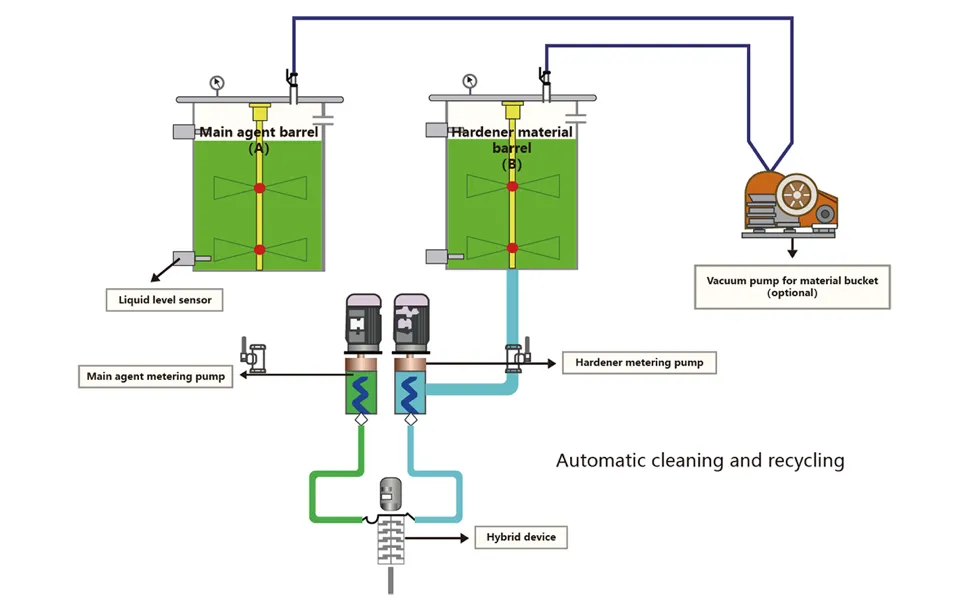
A single vacuum chamber has a built-in bottleneck: every cycle must pump down, pot, and vent before the next part can enter. A 3-stage vacuum box line separates these steps into three chambers that work at the same time. While one part is being potted under vacuum, the next part is already being pumped down and the previous part is being vented. The chambers do not have to repeatedly pump down and vent to atmosphere, so throughput goes up without cutting the vacuum hold time.
XINHUA's XY-DSR4401 Online 3-Stage Vacuum Automatic Potting Machine is built on this principle. It combines two metering pumps (gear and screw pumps can be combined; plunger pumps are optional), dynamic or static mixing, and a PLC with touch-screen control for inline production.
Process parameters that decide your void rate
A vacuum chamber is not a guarantee. We see the same five parameters decide the result in almost every trial.
1. Vacuum level and hold time. Deep enough to pull air out of the geometry, but not so deep that volatile components boil or the compound foams over. Start from the compound supplier's recommendation and confirm it with a cross-section.
2. Dispensing rate. Pouring too fast seals off air pockets before they can escape, even under vacuum. XINHUA potting machines let you set the dispensing speed for each product, in the range of 0.1–50 g/s depending on product conditions.
3. Pour point and sequence. Fill from one side so the compound flows across the part and pushes air ahead of it. Avoid pouring onto the top of tall components. For deep parts, pot in two or more layers.
4. Material temperature and viscosity. Warmer material flows into gaps more easily but has a shorter pot life. Keep the temperature stable, with a heated tank if needed, so that viscosity does not drift during a shift.
5. Moisture control. Polyurethane systems react with moisture and release gas. Keep containers closed, use dry-air blankets where the supplier recommends them, and pre-dry boards that have been stored in humid conditions.
| Mixing choice matters too: when the viscosities or the ratio of the A and B components are far apart, a dynamic (powered) mixer usually blends more reliably than a static mixer tube. Both options are available on XINHUA two-component potting machines. |
When does a vacuum potting line pay off? A decision checklist
Use the checklist below with your own numbers. If you answer “yes” to three or more questions, a vacuum potting line is usually worth a serious evaluation.
| Question | Why it matters |
| Do more than a few percent of potted units need rework, or fail hi-pot or thermal cycling? | Voids are a common root cause of dielectric and thermal failures |
| Is each unit expensive (BMS, inverter, IGBT module, automotive control unit)? | One scrapped unit can cost more than the potting compound in hundreds of units |
| Does your customer audit your potting process or ask for X-ray or cross-section evidence? | Vacuum potting gives you a documented, repeatable process |
| Does the part have tall components, dense pins or closed cavities? | Geometry-trapped air rarely leaves at atmospheric pressure |
| Is manual degassing or long standing time slowing your line? | An inline vacuum line removes waiting time from the process |
A simple payback estimate
Estimate the annual cost of voids like this, using your own data:
Annual void cost = annual volume × void-related failure rate × (rework or scrap cost per unit + share of warranty and field-failure cost)
Compare this with the equipment cost and the estimated remaining failure rate after vacuum potting. Base the remaining failure rate on a sample trial with your own part and compound, not on a general promise. Any supplier who promises “zero voids” without testing your part is guessing.
How XINHUA configures a vacuum potting cell for PACK, BMS and IGBT products
XINHUA offers two main vacuum potting configurations. Which one fits depends on your volume and how the machine connects to your line:
| XY-SR4401 Automatic Double-Liquid Vacuum Potting Machine | XY-DSR4401 Online 3-Stage Vacuum Potting Machine | |
| Concept | Parts are placed in a vacuum box; A and B are mixed at the set ratio and potted under vacuum | Three vacuum stages work simultaneously; no repeated pump-down and venting |
| Typical use | Complex parts, standalone or cell production | Inline, higher-volume production |
| Materials | Two-component epoxy, polyurethane, silicone | Two-component epoxy, polyurethane, silicone |
| Mixing ratio | 1:1 to 20:1 (customizable) | 1:1 to 20:1 (customizable) |
| Control | PLC + PC or teach pendant | PLC + touch screen |
Both machines use two metering pumps. Options include pipeline recirculation and an anti-curing function, which matter when you run filled, thermally conductive compounds. For complete production lines, XINHUA also builds new-energy PACK, BMS, micro-inverter and IGBT potting and curing lines that combine vacuum potting with UV or thermal curing and conveyor transfer. Our recent automotive dispensing and curing line project followed an earlier IGBT three-stage vacuum potting line.
What a sample trial looks like
1. You send the part (or drawings), the compound name and its technical data sheet, and your target cycle time.
2. Our engineers pot samples under vacuum using your compound, and adjust the dispensing rate, pour sequence and vacuum hold.
3. We cross-section or X-ray the samples and send you photos and the parameters used.
4. You receive a machine or line configuration based on what the trial proved, not on catalog maximums.
FAQ
Can vacuum potting completely eliminate voids?
It removes most voids caused by trapped air in the material and the geometry. It will not fix gas generated during cure, such as moisture reacting with polyurethane, or a cure profile that is too aggressive. A trial with your part is the only reliable way to know what void level you can achieve.
What vacuum level is needed for epoxy vs silicone potting?
It depends on the specific compound. Follow the supplier's data sheet, because some silicones and filled systems foam strongly if the vacuum is too deep or applied too fast. The vacuum level and hold time should be confirmed during a sample trial.
Can a vacuum potting machine handle filled, thermally conductive compounds?
Yes, with the right pump and material handling. Filled compounds need pumps that can handle abrasive material, plus stirring or recirculation so the filler does not settle in the tank or lines. XINHUA offers screw and plunger pump options and pipeline recirculation for these materials.
How long does a 3-stage vacuum potting cycle take?
The cycle time depends on part volume, compound viscosity and the required vacuum hold time. The advantage of a 3-stage line is that pump-down, potting and venting overlap, so the line's output is not limited by a single chamber's full cycle.
Can you test my product and compound before I order?
Yes. Send us your part or drawing, the compound data sheet and your target output. We will run a vacuum potting trial and share the results and parameters with you.
Next step
Send us your part and the compound's data sheet. We'll run a vacuum potting trial and send you the results and the parameters we used. Contact our engineering team or read more about vacuum potting machines and integrating a vacuum potting machine into an existing line.