
|
Short answer: Choose by fluid first, then by dot size and speed. Pneumatic time-pressure valves suit low-to-medium viscosity fluids and simple dots or beads. Eccentric screw valves give volumetric, drip-free output for medium-to-high viscosity and filled pastes. Piezo jet valves give non-contact, very small, very fast dots for low-to-medium viscosity fluids on dense boards. |
Most valve problems start at the quotation stage. A buyer asks for "a precision dispensing valve", each supplier recommends the valve it likes to sell, and nobody asks what the glue is. Three months later the line is fighting stringing, dripping, uneven dots or a paste that will not come out at all. This guide gives you a neutral way to compare the three valve types we use most, a selection matrix you can use for a first screening, and a checklist for the valve trial that should come before any order.
Start with the fluid, not the valve
The same valve can work perfectly with one glue and fail with another. Before you compare valves, write down these five facts about your fluid. All of them are on the adhesive's technical data sheet (TDS), or your supplier can give them to you.
• Viscosity and flow behaviour. A thin, water-like fluid behaves very differently from a thick paste. Note whether the fluid is shear-thinning (gets thinner when it moves), because this helps jetting and screw valves.
• Fillers. Thermal pastes, conductive adhesives and some sealants contain hard particles. Fillers wear seals, nozzles and tappets, and large particles can block a small nozzle.
• Cure type. UV, heat, moisture or two-component. Moisture-cure and fast two-component materials can harden inside a valve that stands still too long.
• Pot life or open time. This decides how often the valve must be purged or cleaned, and whether dead volume inside the valve is a risk.
• Temperature sensitivity. If viscosity changes a lot with temperature, a heated nozzle or a temperature-controlled feed may be needed for a stable result.
Then add three facts about the job: the smallest dot or line you need, the number of dots or the bead length per part, and the cycle time you must reach. With these eight points you can already rule out at least one valve type.
How each valve works
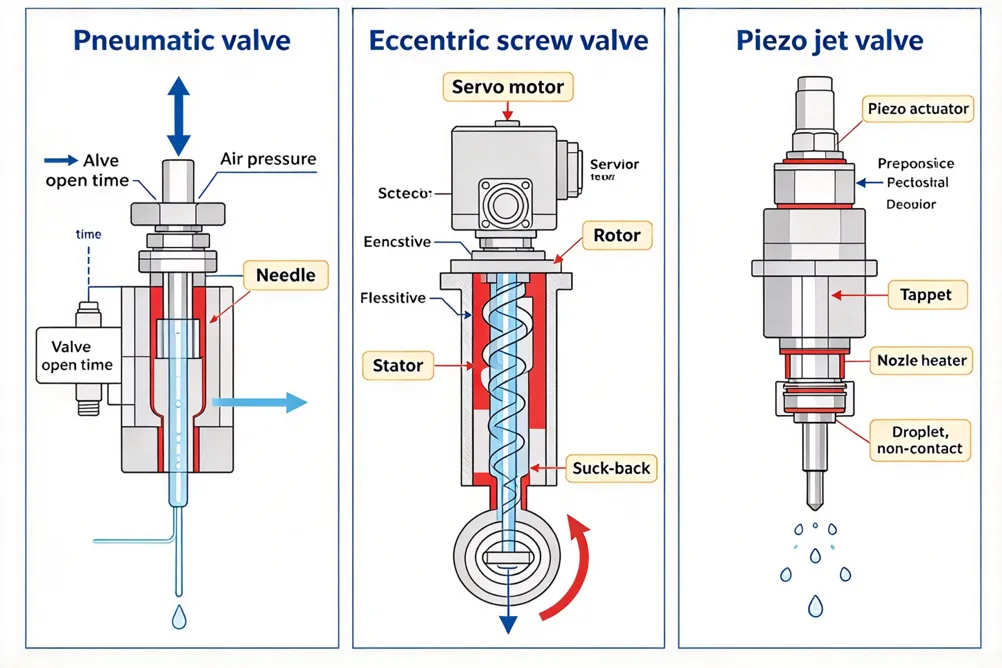
Pneumatic (time-pressure) valve. Air pressure pushes the fluid from a syringe or pressure tank. The valve opens for a set time, and the amount dispensed depends on pressure, time, nozzle size and viscosity. It is simple, low-cost and easy to clean. The weakness is that any change in viscosity, pressure or fill level changes the shot size, because the valve does not measure volume.
Eccentric screw (progressive cavity) valve. A servo motor turns an eccentric screw (rotor) inside an elastic stator. Sealed cavities move the fluid forward, so the output depends on rotation, not on time and pressure. This makes the shot volumetric and much less sensitive to viscosity changes. When the motor reverses briefly at the end of a shot, it pulls the fluid back and stops drips and strings. Our brochure rates our eccentric screw valve for fluids up to 1,000,000 cps, a medium pressure up to 0.6 MPa and a medium temperature up to 80 °C (rated, per brochure; check your fluid in a trial).
Piezo jet valve. A piezo actuator drives a tappet against a nozzle seat at high frequency. Each stroke shoots a small droplet onto the part from a distance, so the nozzle never touches the surface. Jetting removes the Z-axis down-and-up move of needle dispensing, which is why it is fast on boards with many dots. Our piezo valves use replaceable tappets and nozzles made of super-hard material, and a nozzle heater with precise temperature control to bring the fluid into a jettable viscosity range.
The selection matrix
Use this table for a first screening. The ranges are typical for each valve type, not limits of a specific model. The final answer always comes from a trial with your fluid.
|
Criterion |
Pneumatic (time-pressure) |
Eccentric screw |
Piezo jet |
|
Typical viscosity |
Low to medium |
Medium to very high, including pastes |
Low to medium (nozzle heating extends the range) |
|
Smallest dot or line |
Small to medium, limited by needle size |
Medium |
Very small |
|
Speed on many dots |
Medium (Z move per dot) |
Medium (Z move per dot) |
High (no Z move, non-contact) |
|
Contact with part |
Yes (needle) |
Yes (needle) |
No |
|
Shot stability when viscosity changes |
Low, output follows viscosity |
High, volumetric |
Medium to high |
|
Stringing and dripping control |
Basic |
Good (motor suck-back) |
Good (clean droplet break-off) |
|
Tolerance for fillers |
Good |
Good; stator wears with abrasive fillers |
Limited; hard or large fillers wear or block the nozzle |
|
Cleaning effort |
Low |
Medium |
Medium to high |
|
Relative cost |
Low |
Medium |
High |
|
Typical uses |
UV glue dots, simple beads, low-volume lines |
Silicone gaskets, thermal paste, filled epoxies, long beads |
SMT dots, FPC and backlight fine lines, underfill, dense boards |
|
A note on the numbers you see in brochures. Ours rates the piezo jet valve down to about 1 nl per shot, a minimum line width of 0.25 mm, dot consistency within 2% and nozzle heating up to 230 °C. These are best-case figures for specific piezo models with suitable fluids under specified conditions. They are not values that every fluid or every model will reach, and a good supplier will tell you which conditions they were measured under. |
Five common scenarios and what we usually recommend
These are starting points from the fluids we see most often in trials. Each one assumes a typical grade of the material. A different grade can change the answer.
|
Application |
Fluid character |
Usually first choice |
Why |
|
SMT adhesive dots (red glue) |
Medium viscosity, shear-thinning, many dots per board |
Piezo jet |
Fast, uniform dots without a Z move for every component; screw valve is the fallback for larger dots |
|
Fine lines on FPC and backlight parts |
Low to medium viscosity, narrow lines, tight keep-out zones |
Piezo jet |
Non-contact, so no needle touches thin or flexible parts; very small line width |
|
Thermal paste and gap filler |
High viscosity, heavily filled, abrasive |
Eccentric screw |
Volumetric output for thick pastes; jet nozzles wear or clog with hard fillers |
|
UV glue reinforcement (solder joints, connectors) |
Low to medium viscosity, unfilled |
Pneumatic, or piezo jet at high dot counts |
Pneumatic is simple and low-cost for moderate volume; jetting pays off when speed and dot count rise |
|
Silicone sealing beads and gaskets |
Medium to high viscosity, long continuous beads |
Eccentric screw |
Constant flow along the bead, no drip at the start and end point |
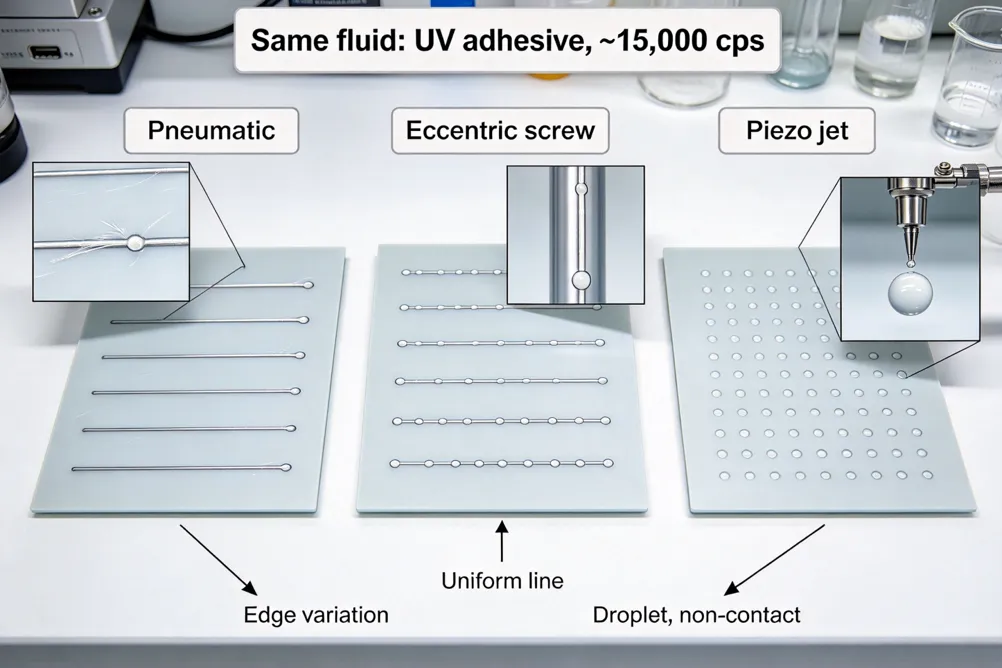
Two warnings from the trial bench. First, a fluid that strings badly on a needle often jets well, because the droplet breaks off cleanly at high speed. Second, a fluid that jets well in a five-minute test can still build up on the nozzle over a full shift. Both points are why the trial matters more than the matrix.
Supply system matters: syringe, pressure tank or 5-gallon pump
The valve can only dispense what the supply system delivers. A good valve on the wrong feed will still give unstable results.
|
Feed option |
Best for |
Watch out for |
|
Syringe or cartridge |
Small volumes, frequent material changes, expensive fluids |
Output can change as the level drops with time-pressure valves; frequent changes |
|
Pressure tank |
Medium daily volumes of low-to-medium viscosity fluids |
Air can dissolve into some fluids at pressure; keep the tank clean and sealed |
|
5-gallon pail pump |
High-volume lines and high-viscosity materials |
Size the pressure so the valve is fed steadily, not overloaded |
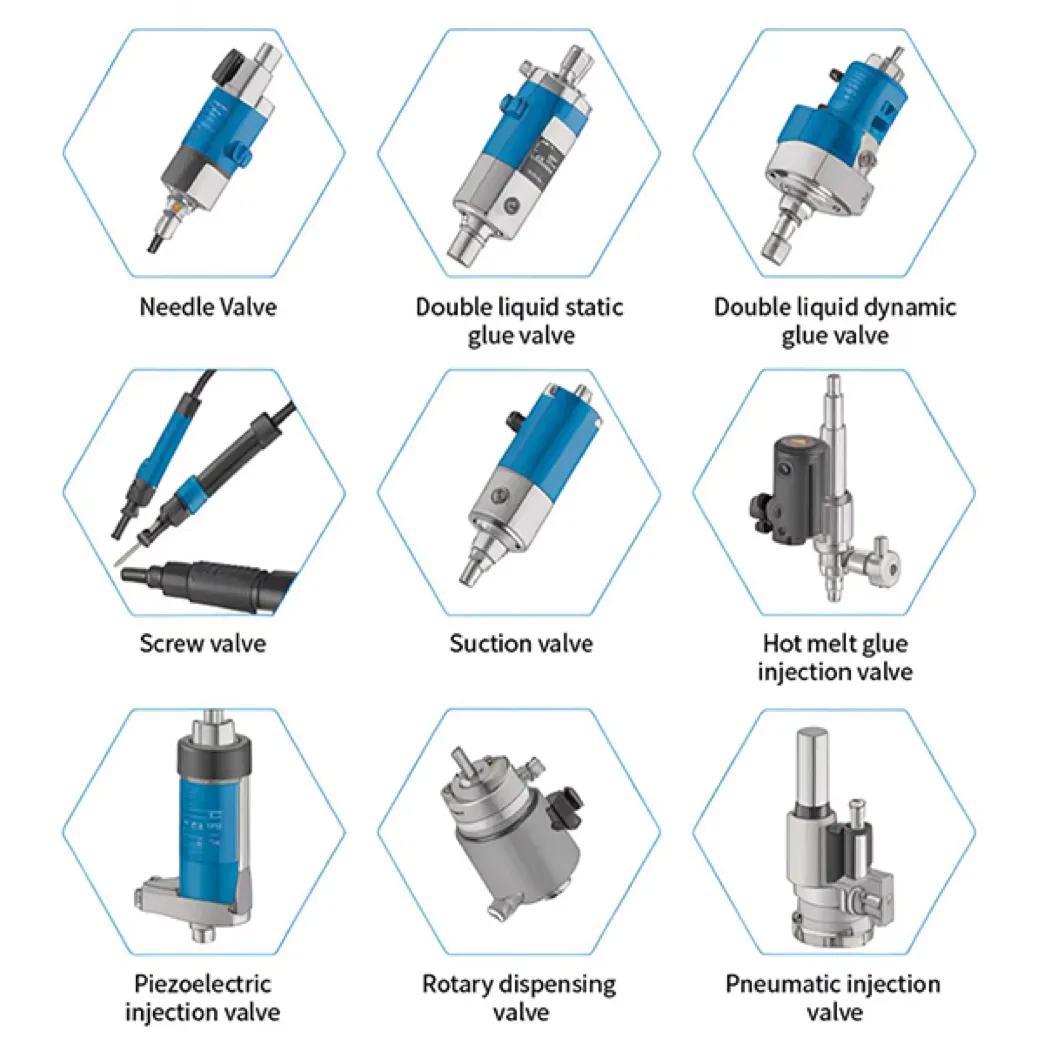
For high-viscosity lines we pair valves with the XY-5GAL 5-gallon adhesive supply pump. It pumps epoxy, polyurethane, silicone, UV glue and other high-viscosity fluids directly from standard 5-gallon (about 20 L) pails, with adjustable pressure for a steady feed. XY series valves can be connected to a feed pump or a pressure tank, and they accept a wide range of needles.
Test before you buy: what a valve trial should prove
A valve trial is only useful if it answers the questions that matter in production. Ask your supplier to run your real fluid, your real pattern and, if possible, your real part. A useful trial report covers these points:
• Dot or bead weight consistency. Weigh a series of shots and report the average and spread, not one good sample.
• Stringing and tailing. Check the start and end of every bead and the break-off of every dot, especially on the last parts of the run.
• Drift over a long run. Dispense continuously for at least the length of a normal production period, then compare the first and last parts.
• Restart after a pause. Stop for a typical break, then restart. The first shots tell you how the valve handles a fluid that sits still.
• Cleaning and changeover time. Time a full clean and record which parts wear. This becomes your maintenance plan.
• Cycle time. Run the full pattern at production speed, including any weighing or vision steps.
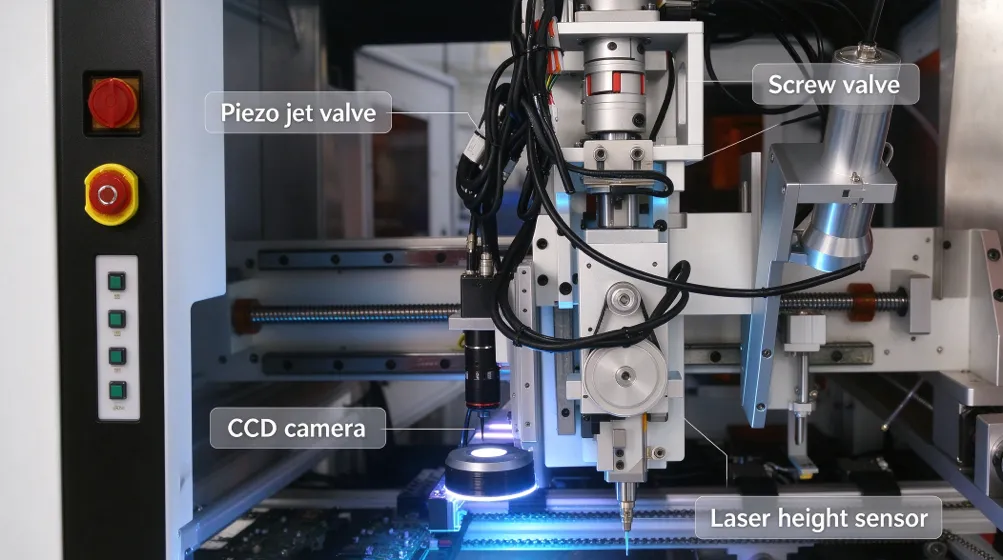
If dispensed volume moves during a long run, the cause is often the process, not the valve. Our guide to inconsistent glue volume and needle crashes explains how weighing, laser height sensing and needle calibration catch this drift. For background on how precision valves control flow and shot size, see our article on the advantages of precision dispensing valves.
Can one machine run two valve types?
Yes, on machines built for it. A dual-valve head can carry, for example, a piezo jet valve for fine dots and a screw valve for a thicker bead, so one program covers both jobs. The XY-G550 / XY-G1200 high-speed intelligent dispensers are listed with piezo or screw dispensing, and the dual-valve version carries two piezo jet valves. They combine CCD vision positioning with laser height measurement, automatic weighing and a purge unit, which helps when you switch fluids.
Valve configurations differ by model and by project. We confirm the exact valve type and feed system in the quotation, based on your fluid and your trial results.
FAQ
Can a piezo jet valve dispense silicone?
Some silicones jet well, especially lower-viscosity and shear-thinning grades, and nozzle heating can help. Highly filled or very thick silicones are usually better on an eccentric screw valve. A trial with your exact grade is the only reliable answer.
What viscosity can an eccentric screw valve handle?
Our brochure rates our eccentric screw valve for fluids up to 1,000,000 cps at a medium pressure up to 0.6 MPa and a medium temperature up to 80 °C. In practice, the feed system and the fluid's flow behaviour also matter, so confirm it with your material.
Is jetting always faster than needle dispensing?
Not always. Jetting is fastest when a part has many small dots, because it removes the Z-axis move for each one. For long continuous beads or large volumes, a screw valve can be just as fast or faster, and it is often the better choice.
Can one machine run two different valve types?
Yes, on dual-valve machines. A common setup is a jet valve for fine dots and a screw valve for thicker beads. Tell us which fluids and patterns you need on one machine, and we will confirm the configuration.
How do I stop stringing with high-viscosity glue?
Start with the valve: a screw valve with motor suck-back pulls the fluid back at the end of each shot. Then check the process: needle height, the retract speed and height at the end of the bead, and the fluid temperature. If stringing gets worse during the shift, check for residue building up on the needle.